If you know me in person, you know I feel strongly about teaching children social-emotional skills and giving them an appropriate space to work through those feelings (whether it’s anger, frustration, sadness, or anxiety). It’s one of the things I am the most passionate about in education. Maybe it’s because I have witnessed first hand how a school environment can help or hurt a child who is struggling to cope with big feelings and challenges. Teachers don’t always realize the damage that can be done, which can take years for a child to work through, when they are not receptive and responsive to a child’s emotional needs. Ignoring it, brushing it aside, or being “too busy” in your day to address it because it is not in the curriculum can be damaging for students during crucial years of their lives. I’ve witnessed it happen with someone near and dear to me, who I love very much. That’s not my story to tell, but it is why I became a teacher. It made me so upset to watch people brush aside what their student was feeling, that I decided at a young age that I would become a teacher and never ever let any child or family feel the way that was felt by the people in this situation.
My relaxation stations have taken many forms over the years, from a carpet with a feelings poster and clipboard that had problem solving prompts to fill out for my students when I taught second grade 17 years ago, to a beanbag with fidget toys and visuals in one of my preschool classrooms 10 years ago, and finally to what it currently is set up as today: a specific designated space in my classroom with various visuals, social stories, and sensory items for my students.
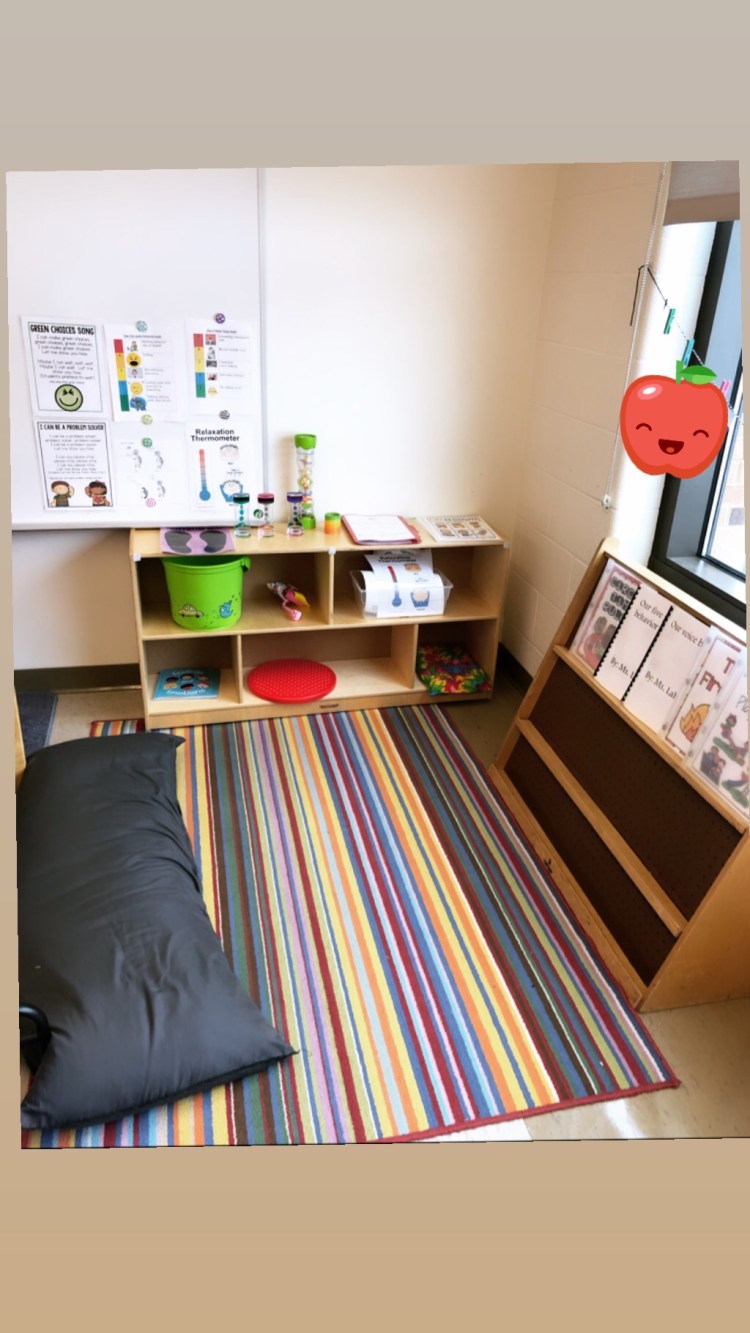
My relaxation station serves a few purposes in my classroom. It is a quiet space that children can go to when they feel like being alone for a few minutes. It is also a place my students go if they are upset and need to calm down. My students know that it is a one person station. They also know it is not a place to go when you don’t want to do something or are avoiding a task. No matter what form it has taken over the years, what I love the most about it, is that it gives the students the tools they need to learn self-regulation skills. These are skills that are taught quickly each day during circle time and are reinforced throughout the day by the adults in the classroom. There are sensory items such as a weighted lap pad, a fidget cushion, squishy balls, light up balls, a body pillow, and a pinwheel. There are visual items such as bubble timers, a slinky, and a rainstick. My visuals include free items from the CSEFEL website http://csefel.vanderbilt.edu, calm down strategies and social stories from Pocket of Preschool’s TPT store https://www.teacherspayteachers.com/Product/Calm-Down-Techniques-Books-Posters-and-Supports-2734315, 5 point scales and social stories that I created, an Emotions felt book from the dollar spot at Target, the problem solving folders I made for my students at the beginning of the year, and pictures of my students’ families, which parents send in at the beginning of the year. It gives my students a safe space to work out their feelings without having to do so in front of all of their classmates. I should note that it is never used as a punishment or a “time out”.
Now it’s your turn, what strategies or routines do you implement in your classroom to assist your students with their social emotional needs?
 The Purposeful Classroom