There can be a fine line between teaching our kids to have empathy and conditioning them to be people pleasers.

As a recovering people pleaser and empathetic person, this is something that I’ve been thinking about lately. How do I teach my own boys and help my students to begin to have empathy for others, while also staying true to themselves? ⁣

When I was pregnant with each of my boys, I would pray (and still do now), that they would be kind, empathetic, helpful, loving, quietly confident, and know their worth. And also…that they wouldn’t let anyone take advantage or push them around. ⁣

When I think about a lot of the general practices out there about for helping kids understand the consequences of their actions, oftentimes the conversations revolve around shaming the offender for hurting someone’s feelings, rather than on listening to all sides and helping everyone to understand how each person feels. You see, when we condition kids to learn that hurting someone’s feelings is wrong or bad, rather than focusing on understanding another person’s point of view, we are laying the foundation to generalize that idea, which in my opinion, helps them grow up to be people pleasers. ⁣

I don’t want my boys to grow up thinking that they have to comply with every direction from every adult or never hurt another person’s feelings because sometimes other people won’t have their best interest at heart. Sometimes doing what’s right for yourself means another person’s feelings get hurt in the process. I also don’t want them to be disrespectful, either. It’s like my Papa used to say “You aren’t better than anyone else, but no one else is better than you, either.” It’s definitely a slippery slope, but here’s how we’re trying to navigate it here at home: ⁣

1) We don’t force our boys to share. No one has to give something up to someone else until they are ready. We remind our boys to ask “Can I have a turn when you are done?”, which helps them to learn to advocate for what they want and also learn how to be in charge of when they decide they are ready. ⁣

2) We try to respond to arguments with “I can see you are both (or sometimes all if it involves all three of them) upset. How can I help?” This way no one feels defensive or is made out to be the one who is wrong. ⁣

3) We try to catch the moments when they are being empathetic and kind in order to point those out. We also point out when they advocate for themself and praise them for that, too.

We certainly don’t have it all figured out, but we are definitely trying to help them learn the balance as they grow.

What happens in our bodies when we are dysregulated?

Self-regulation seems to be a big buzz word in the education environment, but many people are still unsure of what it is exactly. To put it simply, self-regulation is the nervous system’s response to stress. Think of it like this: when our bodies are in a calm, relaxed state, we are regulated. When our bodies are exposed to stress, fear, or overpowering emotion, we can become dysregulated. There has been a lot of research in the areas of neuroscience and psychology that are giving us a better picture of what happens INSIDE our bodies when our body perceives a stressful or threatening situation, so let’s get into it! We can’t start to helping childrenwho are dysregulated if we don’t understand the processes that are happening in their bodies WHEN they are dysregulated.

One of the theories that has provided a wealth of information in this area is the polyvagal theory. It was developed by Dr. Stephen Porges. The vagus nerve runs from your brain stem to your stomach and is charge of some of our automatic body functions such as breathing and heart rate. It is also in charge of things like relaxation, that flight-fight-freeze response, and social interactions.

If you think of your brain as having two parts, it makes it easier to see what happens when we become dysregulated. Make a fist and tuck your thumb inside the closed fist. Then put your other hand on top of your fist. Yes, we have different lobes and areas of our brains, but for this example, think of it as more inner vs. outer brain. Our inner or deep brain (our limbic system) is in charge of what we need to survive (remembering experiences that made us feel good or were unsafe, affect, stress regulation, and sensations). Think of the outer part of our brain as our thinking brain is how we are able to problem solve, process, think, and use language.

When someone encounters a stressful (or perceived stressful) situation, the amygdala (which is kind of like our body’s smoke detector) sends out the alarm and the body responds. Our bodies are MADE to respond to stress, it is a survival skill (which is why we have the flight, fight, freeze response). This is an evolutionary response to stress to make sure we survive. The problem is our brain cannot differentiate the stress between outrunning a lion and being stuck in traffic.

Here’s an overview of how it happens. You are stuck in traffic and stressed that you are going to be late for work. Your amygdala sends the alarm to the hippocampus, which then quickly accesses memories stroed in our brains as safe or unsafe (think of a long drawer in a file cabinet). If it is deemed as unsafe, the amygdala then sends a signal to the hypothalamus, who then sends the necessary information to flee, fight, or freeze to the rest of your body through your autonomic nervous system. Your autonomic nervous system has two parts – the sympathetic nervous system and the parasympathetic nervous system. When the hypothalamus sends out it’s signal, your brain is focused only on surviving that stressful situation and as such your access to the area of your brain such as problem solving or language is not available. It is so automatic that your brain starts this process before it even has a visual perception of what is happening. Think of people who jump in front of a moving bus, run into a house fire, or are able to lift a car to save someone. Their outer or thinking brain did not problem solve what to do, their body just responded based on the signals sent by their brain.

Tying all of this into the behavior chain analysis model (trigger-thought-action-consequence) can give us a better picture of what happens to our kids when they “flip their lids” as Dr. Jody Carrington says in her book “Kids These Days”, and just how quickly it can happen.

Trigger – A child encounters a stressful (or perceived stressful) situation and the amygdala sends the signal to the hippocampus.

Thought -The hippocampus sends the signal that this event is similar to one that the child has experienced before, which was stressful, traumatic, or uncomfortable.

Action – The child flees (avoidance), fights (verbally, physcially, or damages property), or freezes (shuts down).

Consequence – What then happens to them as a result of that whole cycle that either reaffirms that what happened was stressful and unsafe or can help them form new memories over time to differentiate more between safe and unsafe behaviors.

So what do we do to help kids during that cycle? We will explore this more in depth in the next blog but for starters, we can make sure to help the child feel safety and offer empathy (this does not mean we do not still hold the boundary for them).

Here are some of my favorite places to learn more about self-regulation and our body’s biological responses to stress and trauma:

Dr. Jody Carrington

Dr. Becky Kennedy

Self-Reg: How to Help Your Child (and You) Break the Stress Cycle and Successfully Engage with Life

The Whole Brain Child – Dr. Dan Siegel and Dr. Tina Payne Bryson

References used for this blog post: Limbic System: Amygdala, Hypothalamus, Thalamus (thoughtco.com), Understanding the stress response – Harvard Health, The thinking brain versus the emotional brain – Thoughts on Life and Love, and information from starr.org from their trauma and resilience certification classes.

I would love to hear your thoughts or experiences with this! Please be sure to leave them in the comments.

Using Starr Commonwealth’s Universal Needs to help plan for the school year during uncertain times

I don’t know about you, but this is a crazy year for trying to prepare for the beginning of the school year. Whether your school has chosen to return virtually, with a hybrid model and social distancing measures, or returning full time (5 days a week with social distancing measures), nothing about this year seems normal. I was just telling a teammate the other day that we all feel like first year teachers this year because….we’ve never taught during a pandemic before. It can all feel very overwhelming and daunting, so here is what I did.

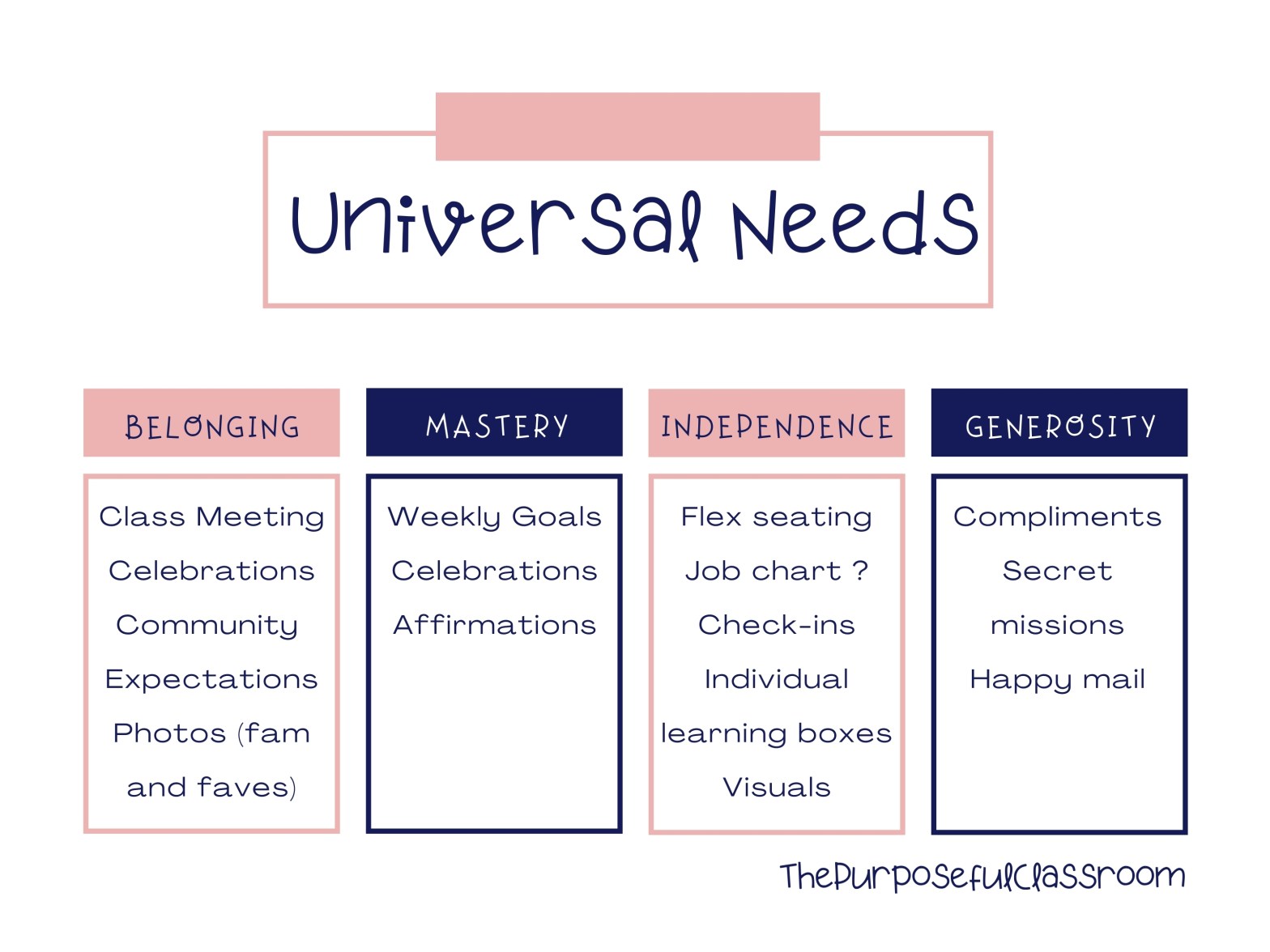
If you remember from my post about creating pillars that you will use during the year as the framework for your procedures, while creating meaningful relationships with your students, and while delivering your content, Starr Commonwealth’s Four Universal Needs are: belonging, mastery, independence, and generosity. If you haven’t read it, you can find that blog post here: https://thepurposefulclassroom.com/2020/07/05/simplify-your-classroom/

I decided to take the four universal needs and list out my procedures and components that I utilize in my classroom. My goal is to now use my experience and knowledge as an Intervention Specialist and figure out how to make accommodations to these procedures so they will work with social distancing for my kindergarten students. I will also be trying to figure out how to make them work virtually, in the event that we end up going remote again at some point. For example, when looking at flexible seating, my idea is to tape an area on the floor for my students that is their “spot”. In their space, they can choose to use their classroom chair, stand up if they need to, or they can take out the classroom stool or scoop seats that I have in the classroom. My plan is to offer each student a flexible seating option that is theirs for the whole day. The option will be stored under their table so that they can easily swap it out and then it will be cleaned at night. As I unpack more of these procedures I will be sure to share how I plan on making them work in my classroom.

I hope wherever you are and however you are starting your year, that you are taking deep breaths, enjoying your last days of summer, and remembering that this is REALLY hard, but like Dr. Jody Carrington says, “We are wired to do hard things.” Please don’t forget to give yourself and others grace during this difficult start to the school year. Sending you good thoughts and rooting for you always, friends!

Simplify Your Classroom

How do you set up your classroom for success? ⁣

It’s July and that usually means seeing ALL of the back to school posts. I’ve seen quite a few already, even though most of us don’t know what next year will look like. ⁣

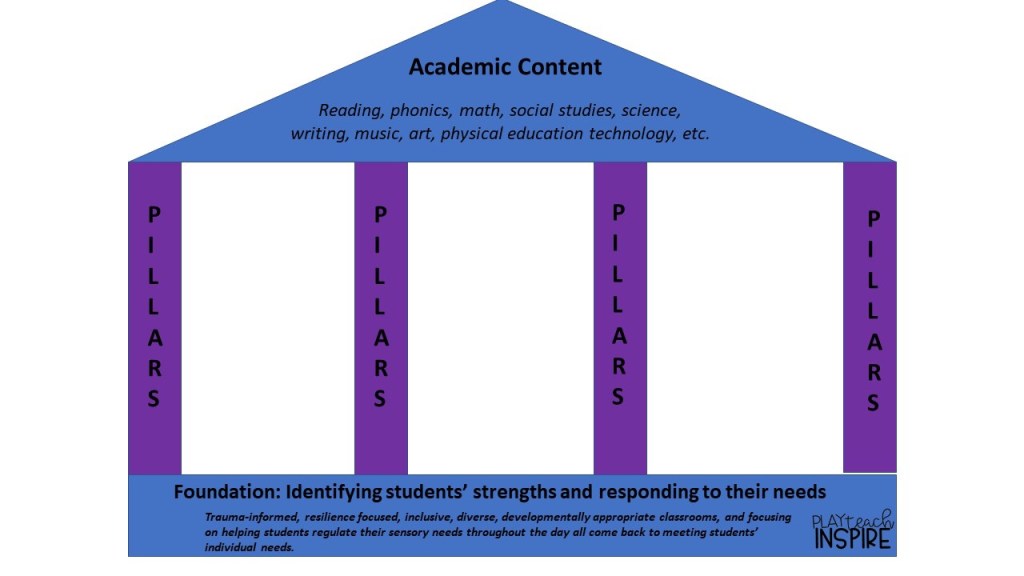
As someone who has taught for 18 years and spent time as both a general education teacher and special educator, taken numerous classes on being trauma-informed and resilience focused, and is actively working on becoming anti-racist, I know that trying to do all of these things can feel like A LOT….so I made a visual that helps me to organize it all and hopefully it’s helpful to you as well. ⁣

Simplify Your Classroom by putting students’ needs first

The best analogy I can think of, is this – setting up your classroom is a lot like building a house. To build a house that is sturdy, you have to get dirty. You have to dig in, literally. When building our classrooms, we need to dig into information and research on things like: trauma-informed care and what that looks like, resilience, inclusion, diversity, brain functioning, sensory functioning, and developmentally appropriate practice…it’s a lot. I just want to pause here for a minute. Take a collective breath with me. I’m going to share with you something that hopefully helps you to align all of these.

By getting a better understanding of those topics, you can then lay the foundation of your house. You absolutely should do your own work on understanding all of these topics and be as well read and versed as you can be, however, as someone who has two degrees, is working on a certification, and has presented on some of these topics over the years…here’s what I want you to know. The components that run through each of these topics in education are this: meeting students where they are, creating connections, using a student’s individual strengths to reach and teach them, and responding to their individual needs. It means you see every child as the unique individual that they are and start there. What systems are you going to put in place in your classroom to be able to do this? Are you going to have flexible seating, movement breaks, etc? Are you going to allow the students to get up and move when they need to or have a snack if they need it (did you know eating can regulate yourself if you are feeling dysregulated)? If the answer to the second question is no, think about why that is. Is it for compliance? Safety? Think about professional development or staff meetings. Are you able to get up out of your seat or eat? Why do we expect children to act in a way that adults, actually their teachers, do not? No judgement, just genuinely asking.

The next part of simplifying your classroom is to decide what the pillars of your classroom are built around. I have a whole IGTV on this on my Instagram. You can find the video here: https://www.instagram.com/p/CB3yrblhvhM/ Mine are the same as Starr Commonwealth’s Four Universal Needs : Belonging, Mastery, Independence, and Generosity. You can find out more about those here: https://starr.org/universal-needs/

After you have spent time building your foundation and creating your pillars, then you can add the roof, which is all of the academic content we teach. You may be wondering why I arranged them in this order or thought of them as house and here’s the thing that kept coming back to me. You can try to build a house without a foundation, but it won’t stand for very long. Just like a house without a foundation and support beams, a child who is stressed, struggling, or is not having one of their universal needs met, will collapse under the weight of all of the academic and cognitive content we are throwing at them. A stressed brain cannot learn.

I hope this was helpful for you to see that while we have a ton of things to juggle in education, all of the things aren’t meant to be in separate silos. They’re all meant to be together in one house (kind of like the Real World, but without the dysfunction 😂). In all seriousness though, we need to make sure we are building the strongest houses possible for our students. They deserve it.

Interested in hearing more about this? You can follow me on IG: https://www.instagram.com/thepurposefulclassroom or shoot me an email at shannon@thepurposefulclassroom.com

First Then boards

First then boards (or if we really want to get fancy, this is called the Premack principle) are a great visual resource to use for students as well as kids at home to help break up their day into smaller, manageable chunks. This strategy is also great for helping children to complete a non-preferred task! Simply place a visual of what you want them to do in the “first” box and then place a visual for the reinforcing reward in the “then” box.

Don’t have a lot of visuals to use at your disposal? No problem! You can just use a tray and place a clip art picture of a heart (or any shape you prefer) on the tray. Use this tray to place the non-preferred task on. Then just put the same heart or shape you used for the tray onto the “first” box. It makes it super easy because you don’t have to keep switching out visuals, except for the reinforcing visual you use for the “then” box. When you want your child to complete different tasks, simply switch out the activities on the trays!

Examples of reinforcers can be time on the ipad, toy cars, squishy toys, jumping on the trampoline, a slinky, putty, play dough, a certain snack, etc. Really anything that your child is interested and motivated by can be used as your reinforcer.

We use these at home with our boys for things like: eating their dinner (first dinner, then dessert), cleaning up their toys (first pick up legos, then ipad), and getting ready in the morning (first get dressed, then legos). It truly is a simple strategy that can be tailored to your child’s needs. I also love that the visuals are reinforcing the language that your child will be hearing and processing. Remember the tip on my Instagram story yesterday about time delay? So many times, in my experience, refusal is about more than just a child deciding that they don’t want to do something. There is always a function to a behavior – but…more about that another day.

Click here to get your free copy of a First Then mat to use with your kiddos!

First Then Mat

Thanks for stopping by and reading! I would hear about how you are using this resource in your homes or classrooms and how it is going!

Stay healhty!

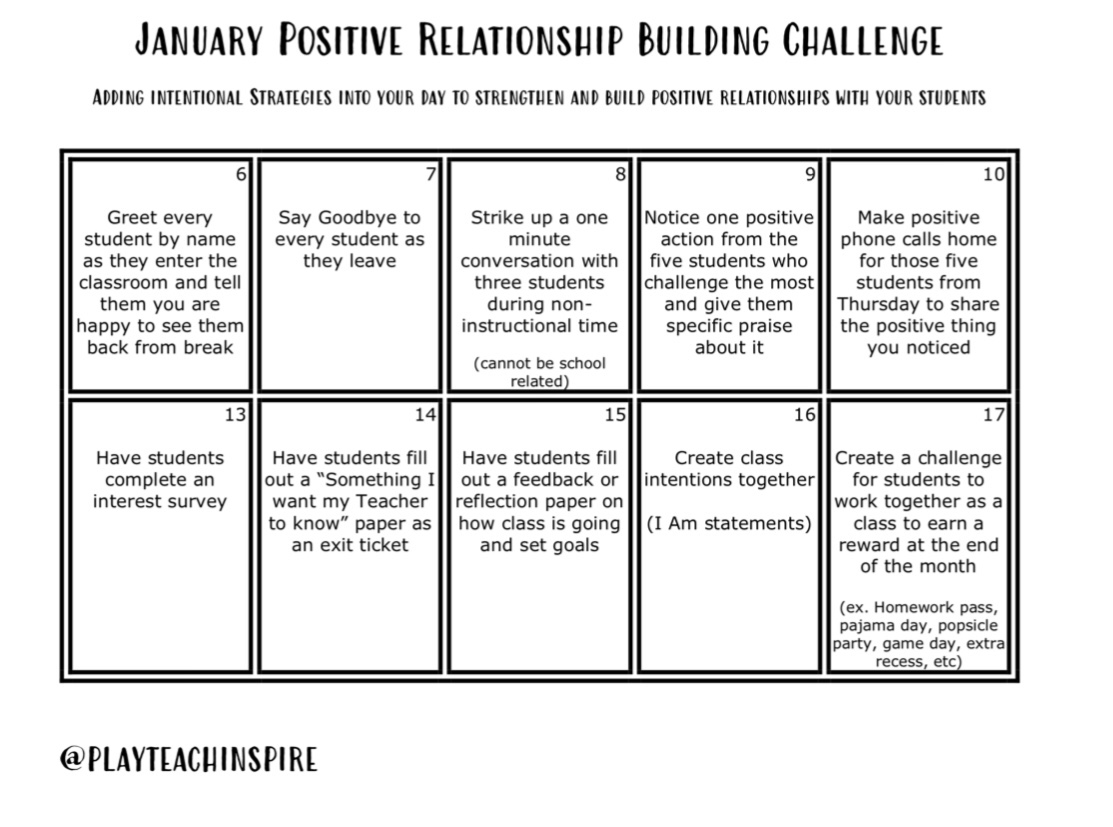
Positive Relationship Challenge

Today is the day! We are so excited to share our 10 day positive relationship building challenge with you all!

We created this challenge as a way to reconnect and strengthen the bonds we have with our students after the extended break. Remember that you already have a relationship with each of your students, the key is to make sure it’s a positive one.

This challenge would also be great to try if you are finding a way to connect with each of your students if you haven’t yet or if you are starting over because it’s a new semester.

These are quick, easy ways to build or continue to strengthen those positive relationships with your students. If there is a need to use any kind of form, we will post it here for you the week before. No need to add any extra work to your plate or create anything if you don’t want to. We want to make it as simple of a process for you as we can.

We are so passionate about this because we have seen time and again over all of our years of teaching, just how vital positive relationships are to student and classroom success. It sets the tone for the whole year! We will also be sharing a video to our Instagram account the day before that explains how we put these strategies into practice in both an early childhood and middle school setting.

Who’s ready to join us?

How I build relationships with students

I’ve had a few people DM me on Instagram and ask me how I create relationships with my students. We all know that relationships are the foundation of any successful teaching that will occur in your classrooms! Here are 5 simple strategies I use to help develop and strengthen my relationships with students (including those that are hard to reach or have been through trauma). ⁣

1. Find out about their interests – this can be as simple as an interest survey at the beginning of the year. What you teach is important but what parents and students really want to know is that you care and that your students are physically and emotionally safe with you in your classroom. When I taught older kiddos, I created an “all about me” for them to fill out as a way to find out their interests. The last question was always, “What do you want me to know about you?” With teaching preschoolers now, I have a quick parent questionnaire that I do over the phone, in person, or via email to find out things like their child’s favorite snack (I strive to make sure we have everyone’s favorite snack within the first few weeks of school, even if it means buying it myself). The last question I ask the parents is always “What do you want me to know about your child?” ⁣

2. Greetings and Goodbyes- Greet every child as they come in and make sure to let them know that you are happy and excited to see them at school each day. Likewise, say goodbye to every child as they leave. My students get to pick if they want a hug, handshake, high five, or fist bump. There is always the option for them to wave as well if they don’t want to do any of those. Does it mean you may need to pack up a little earlier? Possibly, but I promise those few minutes of interaction every day will do more for your students and their learning overall than anything you could be squeezing in to teach for those five minutes at the end of the day.

3. Check in with each student every day – spend time having a 1:1 conversation with every child. Make eye contact. Follow up with something they told you the day before. It doesn’t need to be long, it just needs to be meaningful. Think of the times in the schedule when you can squeeze these in: arrival, lunch, snack, transitions, dismissal, etc. If you have a student who is really struggling behaviorally, use Raymond Wlodkowsi’s 2×10 strategy: spend two minutes a day for 10 days in a row having non-academic conversations with them. You can check out his study for all of the results but they were pretty significant. ⁣

4. Stop and Listen – it’s as simple as it sounds. If a student is telling you something, no matter how trivial, it’s because it’s important to them. Stop and listen as often as you can. It will help them to know that you care and will help you learn more about them. ⁣

5. Focus on the behaviors you want to see increase – Praise them for whatever it is you want them to do. Praise them for completing each step along the way. Let them choose their classroom incentives or rewards they want to work for. Use selective ignoring appropriately. This doesn’t mean your room is a free for all, it just means you stop nit-picking every little thing. ⁣

These are five strategies I use when building and strengthening relationships with students. I’d love to hear yours! Drop me a comment with your favorite strategy to use!

#traumainformedcare #selfregulation #socialemotionallearning #momlife #teachermom #teacherblogger #teacher #teachersfollowteachers #teachersofinstagram #iteachtoo #iteachpreschool #boymom #integratedpreschool #specialeducation #specialeducationteacher #teacherlife #worklifebalance #earlychildhoodeducation #mommy #spedteacher #preschool #earlychildhoodeducator #teachertribe #teachersofig #teachersofinsta #weteachsped

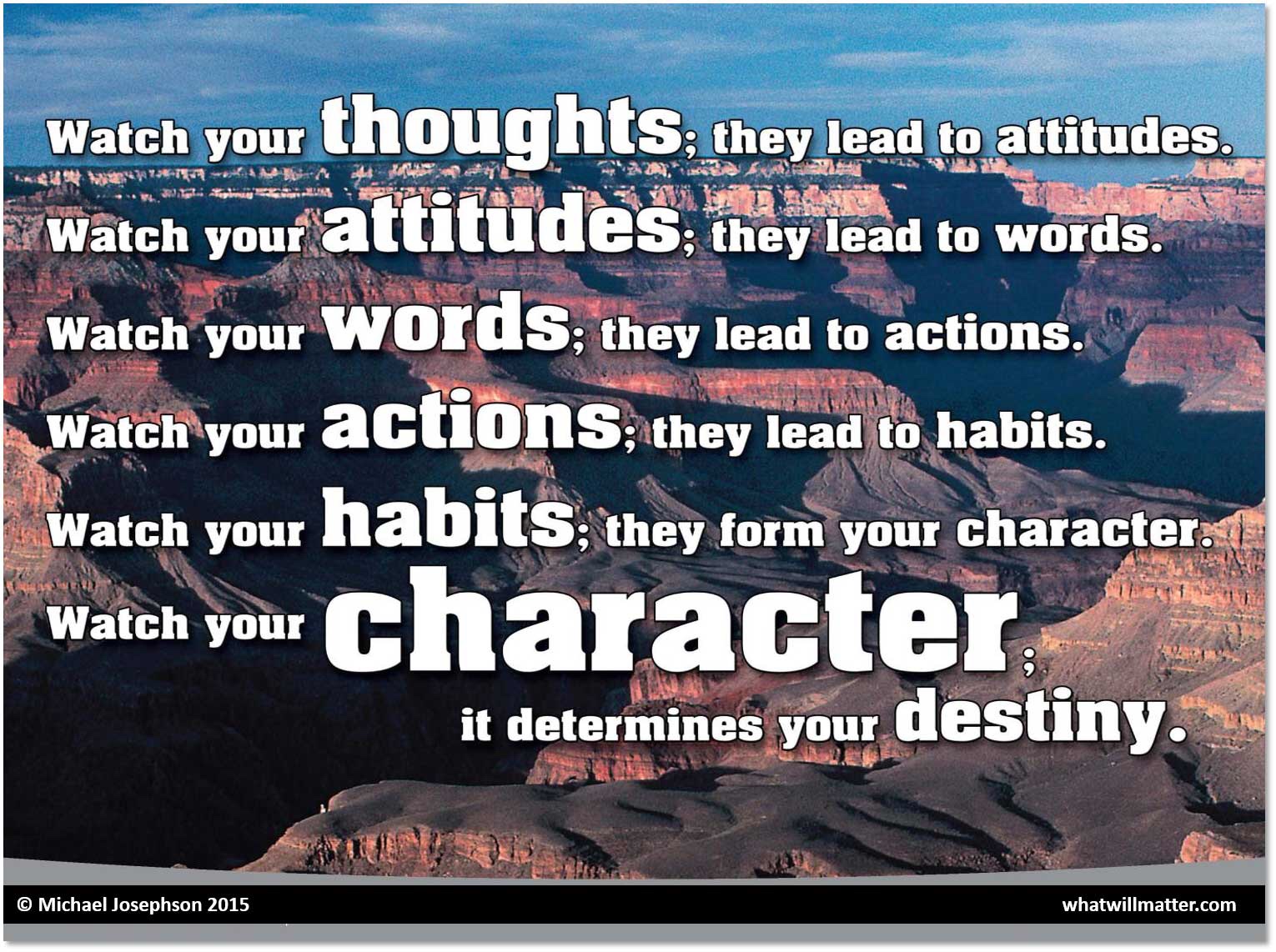
Your thoughts determine your relationships…

Can we talk about this and how it applies to education for a minute? A few things before I dive into this… I 100% agree with the people who say that educators and schools are unfairly judged by society and the people who make the educational decisions in this country. They don’t truly understand what it takes to be a teacher or what is going on in any of our classrooms on a daily basis. They never will until they spend the time actually IN the schools and classrooms that they judge and become more informed about what is actually happening in those classrooms. That’s not what this post is about though.

This post is about how our thoughts can affect our interactions with our students and their families. Every day, your students show up in your classroom and you have NO idea what their morning was like. You also have no idea what that morning was like for their parents either. If you are a fellow parent and are the one who gets everyone ready and then drops your children off at the sitter’s house, daycare, or school, I know you will understand this. Some mornings it’s like working a full day BEFORE work to get everyone out of the door on time.

My three year old is as determined as a mule. I choose to use determined over stubborn because it just has a better connotation, but you all, he makes me question everything I know about child development daily. 😂 All joking aside, he (and his little brothers) make me a better person and teacher daily.

He HATES to get dressed every single day. He hates to take off the pull-up he wore to bed (which is usually dry) and put on his underwear. Most days, he hates to brush his teeth, put on his shoes, or get in the car to go anywhere, even if it’s the weekend. Before you all hit me with the sensory piece, as a special educator, I recognize that there is probably some sensory pieces and a little anxiety mixed in there but overwhelmingly for him, it’s about control. He’s a homebody and nothing makes this kid happier than staying at home and playing with his toys every day. He’s just content at home.

My point for telling you about my son is this: today, he woke up easily. He was excited to leave and go to the babysitter’s house. He brushed his teeth, changed out of the pull-up, put on his coat and shoes, ate breakfast, and walked out of the house easily. He did everything he fights me on every morning, except one…he wanted to wear his Blippi pajamas today. When he gets into something, this boy goes all in with his whole heart (he is determined after all). When he was younger, we went through a Mickey stage, which then became a Star Wars stage with some Puppy Dog Pals, Muppet Babies, and PJ Masks sprinkled in there. Right now, we are in the thick of the Blippi stage. He has a pair of pajamas (that came with a hat) and the orange glasses. He would wear them and sleep in them 24/7 if we let him. He even insisted on taking a toy fire truck to bed last night (thanks, Fire Truck song).

So I was faced with a decision…do I rock the smooth morning we were having (which rarely happens) and make him get dressed or do I let him just wear the stupid pajamas? I chose the later. Not because it was easier for me, but because I want him to have a successful morning and (hopefully) build off of it in the future. Maybe seeing how easy mornings can go and that the things I’m asking him to do aren’t a big deal, will snowball us into better mornings. 🙏🏻

What’s my point in telling you this long-winded story about my son’s morning? It goes back to the beginning of the post. You have NO idea what your students or their families have had to deal with in the morning. So if you saw my three year old out in pajamas but didn’t know our context or reasoning behind that decision, you could make all kinds of judgements about me as a mom. You could think I’m lazy or give in to my kids or let the kids call all of the shots (none of which are true). You have no idea what your students and their families deal with when you aren’t around. The truth is, you have very little interaction with your students’ families outside of emails, conferences, and phone calls (and hopefully you are having positive interactions and not just interacting when there is an issue). So here’s what that means for me. It starts with my thoughts. I CHOOSE to believe that every parent/guardian is doing the very best they can for their kids. There are no perfect people, parents, or teachers. I have no idea what the adults have been through in life or what their home life is like. I don’t know how much food they have or if they’ve gone hungry just to make sure their kids get at least one meal a day, even if it’s an unhealthy choice because that’s all they can afford. If I were to judge them because I don’t think they parent like I do or think like I do, who wins? The answer is NO ONE. If I make a judgement, even if I just think it and don’t say it out loud, I’m subconsciously removing myself from being on the same team with my students and their families. Isn’t that the point, though? To be on the SAME team? To make it a successful environment for your students both at home and school by working together and helping your students to generalize the skills at home that they’ve learned at school? I also CHOOSE to believe that kids do well if they can, but that’s an different post for a different day.

Circling back to the picture, your judgements affect your interactions with students and their families. It affects their year with you, which can also affect the next year and so on. It affects their future relationships with their future teachers and their assumptions about teachers and schools in general. It affects their lives. There’s already enough finger-pointing in education and not enough solutions. Let’s start by practicing what we preach and showing kindness for others through our thoughts, words, and actions. Imagine the impact THAT would make.

FYI- To be clear, I am not talking about ignoring signs or not making a call if there are signs of abuse or neglect – all school personnel are mandated reporters. If you suspect a child is being abused or neglected, you are required to report that.

Be the change

I took this picture of my sweet boy at 4:30 this morning. He had woken up around 1:30 and came downstairs to find me asleep on the couch (hello, third trimester). He’s too heavy for me to carry back upstairs so we snuggled on the couch until he fell back asleep.

After I snapped this picture, I opened up my phone and read about the tragedy in Dayton. It’s always horrific to read about senseless violence and tragedies, but this one hit close to home. I spent 4 years at UD while getting my undergrad degree. My brother, sister-in-law, nephew, and niece all live in the Dayton area.

We need to change a lot in this country to make it safer and it’s not a one solution fix: gun reform, greater access to mental health resources for all, and teaching kids how to manage their emotions so that they grow up to be adults who manage their emotions are just some things that come to mind. It’s hard to not feel helpless, as many of these initiatives need to be taken and ultimately decided on by the state and federal government. It’s frustrating when people can’t or won’t make the changes that are so desperately needed, even when research and statistics show otherwise.

Here’s what we CAN do though. We need to start realizing in this country that words have power and once you say something, you can never get it back. We need to stop being angry all of the time and yelling at each other. We need to stop making blanket judgments about huge populations of people based on where they were born, how they worship, who they love, how they look, their socio-economic status, their abilities, etc. I tell my preschoolers and my own children that you are free to make your own choices, but you are not free from the consequences of those choices. The same can be said for words. We have freedom of speech, but you are not free from the consequences of your words, the weight they carry or the impact they have on others.

Kids do not come into this world with hate and judgement. Those are things that are TAUGHT. Kids hear and see everything, even when you think they aren’t paying attention. The way you CHOOSE to handle a situation or speak about a situation, is teaching all of the children in your life, not just your own, how to handle similar situations. If we want to make a change, while we are waiting for those who can do something to actually do it, we can start by choosing words of kindness and compassion, leaving hate and judgement out of our households and everyday language. It’s the least we can do for our children to teach them how to grow up with empathy, understanding, and compassion for others. Do a random act of kindness today. Be a little more patient. Inspire the kids (and adults) in your life to do better by being better.

Saying prayers today for all of the victims and their families. I will also be praying that my boys and husband will never be in a place where something like this happens, as well as our family, friends, co-workers, and everyone else we know. And I will be continuing, as always, to pray that something like this won’t ever happen again.

Social-Emotional learning in action through relaxation stations

If you know me in person, you know I feel strongly about teaching children social-emotional skills and giving them an appropriate space to work through those feelings (whether it’s anger, frustration, sadness, or anxiety). It’s one of the things I am the most passionate about in education. Maybe it’s because I have witnessed first hand how a school environment can help or hurt a child who is struggling to cope with big feelings and challenges. Teachers don’t always realize the damage that can be done, which can take years for a child to work through, when they are not receptive and responsive to a child’s emotional needs. Ignoring it, brushing it aside, or being “too busy” in your day to address it because it is not in the curriculum can be damaging for students during crucial years of their lives. I’ve witnessed it happen with someone near and dear to me, who I love very much. That’s not my story to tell, but it is why I became a teacher. It made me so upset to watch people brush aside what their student was feeling, that I decided at a young age that I would become a teacher and never ever let any child or family feel the way that was felt by the people in this situation.

My relaxation stations have taken many forms over the years, from a carpet with a feelings poster and clipboard that had problem solving prompts to fill out for my students when I taught second grade 17 years ago, to a beanbag with fidget toys and visuals in one of my preschool classrooms 10 years ago, and finally to what it currently is set up as today: a specific designated space in my classroom with various visuals, social stories, and sensory items for my students.

My relaxation station serves a few purposes in my classroom. It is a quiet space that children can go to when they feel like being alone for a few minutes. It is also a place my students go if they are upset and need to calm down. My students know that it is a one person station. They also know it is not a place to go when you don’t want to do something or are avoiding a task. No matter what form it has taken over the years, what I love the most about it, is that it gives the students the tools they need to learn self-regulation skills. These are skills that are taught quickly each day during circle time and are reinforced throughout the day by the adults in the classroom. There are sensory items such as a weighted lap pad, a fidget cushion, squishy balls, light up balls, a body pillow, and a pinwheel. There are visual items such as bubble timers, a slinky, and a rainstick. My visuals include free items from the CSEFEL website http://csefel.vanderbilt.edu, calm down strategies and social stories from Pocket of Preschool’s TPT store https://www.teacherspayteachers.com/Product/Calm-Down-Techniques-Books-Posters-and-Supports-2734315, 5 point scales and social stories that I created, an Emotions felt book from the dollar spot at Target, the problem solving folders I made for my students at the beginning of the year, and pictures of my students’ families, which parents send in at the beginning of the year. It gives my students a safe space to work out their feelings without having to do so in front of all of their classmates. I should note that it is never used as a punishment or a “time out”.

Now it’s your turn, what strategies or routines do you implement in your classroom to assist your students with their social emotional needs?